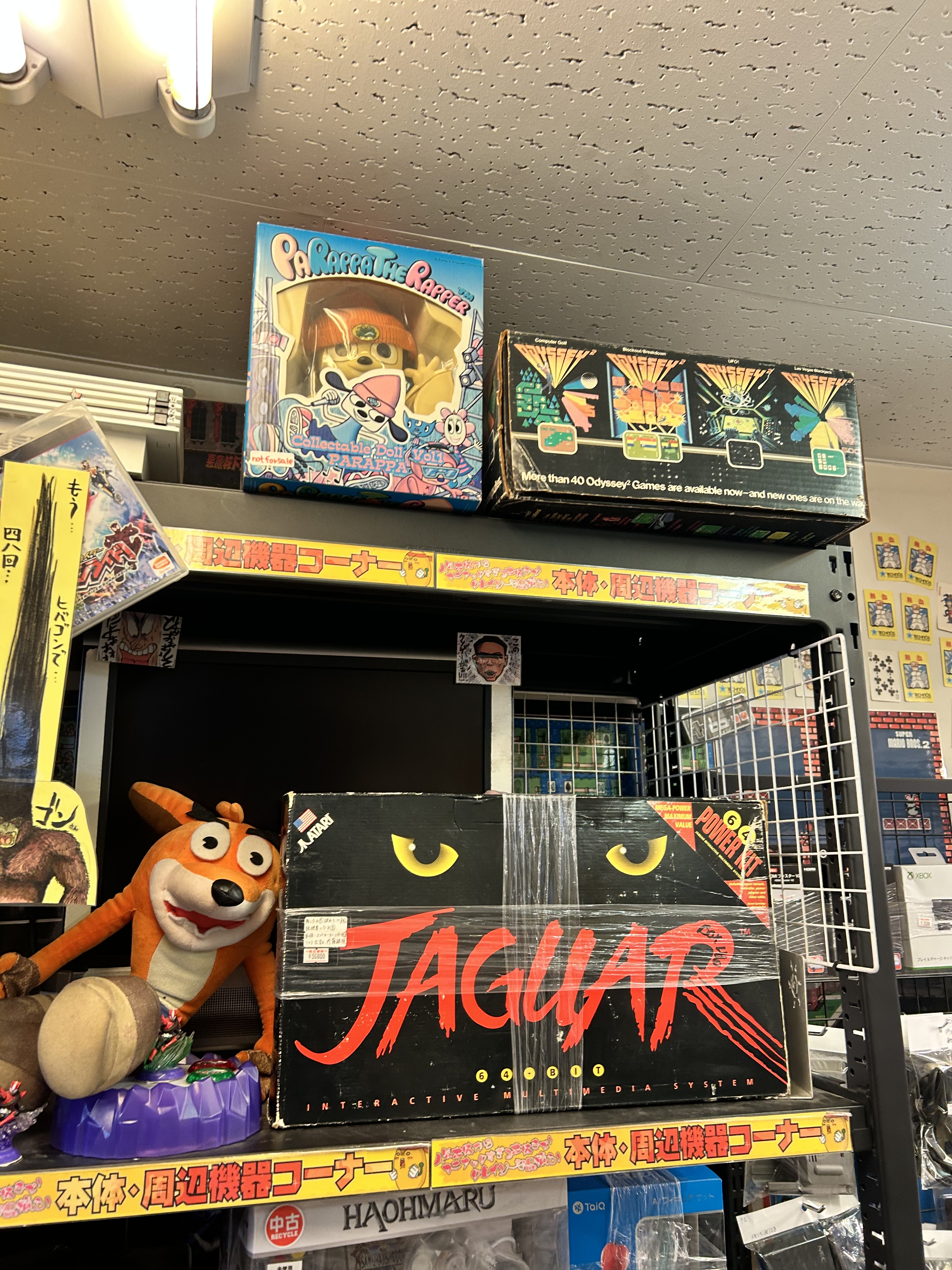
Video games have earned a respectable place in the creative arts as a medium of enigmatic computer prowess. Few players dare delve into the inscrutable realms of computer graphics, as the formula for matrices and vectors of three-dimensional values somehow translating to jiggling physics, dynamic shading, and interactive environments, can be quite perplexing. Today, gaming has matured drastically, whereby we can draw distinctions between generations defined by the consoles that supported its development. For the titles that have faced the test of time, many have earned laurels for their sentimental value, innovation, and rarity, among other qualities. Surrounding these games is an entire community of enthusiasts and curious people of all ages engaging in many ways with the preservation and influence of game history.
I have been a follower of the retro gaming community for quite some time now. While generationally apart, I had a deep appreciation for older games and their lore from an early age. As a result, I committed a large portion of my free time in my teens to catch up with all the gems of the various periods of video game history. As a kid, I played on my PS2 mostly the casual Disney games, along with racing games, and honestly not too much variety. By the time I was a teenager, I got a PS3 and got introduced to some great games including the Uncharted series, which I cherish dearly. Over time, I became more exposed to retro gaming, having done research online and mindlessly searching YouTube for gameplays and other commentary at a time before algorithms got too good at recommending content. Eventually, I ended up stumbling across the nascent online retro gaming community with creators like Pat the NES Punk, LGR, and most notably AVGN.
With some of the best crude humor mixed with creative genius and a love for old games, James Rolfe’s portrayal of AVGN imbued in me a kind of curiosity that I would take with me on the vicarious adventures of eccentric discovery and jokester (yet veritable) criticism on some fine pieces of computer entertainment with the nerd. Through AVGN, I think my interests in collecting retro games were propelled significantly as I scoured through eBay trying to find the games he reviewed or that interested me. Now, of course, being a teenager meant not having the kind of money to partake in any kind of serious “collection” of any sort, but I was always enthusiastic about emulating and so I was quick to set up on my old Samsung tablet emulation of consoles such as the venerated NES, SNES, Genesis, PS1, and PSP.
I vividly remember playing games like Starfox, Super Metroid, Earthworm Jim, Super Mario, Crash Bandicoot, and later Resident Evil (as scared as I was of playing it initially). Funny that I endured playing those games on a tablet, considering how much I am against the loss of tactility from using our hands directly on the screen as opposed to with physical joysticks and buttons. Eventually, I was able to afford an introduction into the vintage gaming collection enterprise. In part thanks to my initiative to buy and sell my own “retro stuff” online on eBay, I explored various markets in my city, scouring for old stuff that would be enticing for online buyers, and I want to say I had a decent eye. I got to sell stuff ranging from old film projectors, cameras, a Game Boy color, some cassette recorders, and really anything that caught my eye as valuable and in restorable condition. My collection really began with a game a friend gifted me in 9th grade, if I am not mistaken, Crash Bandicoot 2: Cortex Strikes Back. Having already played the games to some extent previously, I was quite thrilled to have a PS1 game in my hands, and soon I would buy the first and third games in the Crash series within the year. By the time I was a senior in high school, I proudly owned an original PS1, which I got for $5, a DualShock and original controller (the one without the joysticks), MGS1, Syphon Filter, RE3, and a bunch of other games. At some point, I even owned a ColecoVision with some generic asteroids and tank games.
My collection endeavors continued throughout college, and with a part-time job, I was able to save up for more games I had been eyeing. Of course, with emerging purchasing power and responsibilities, I had to be strategic about spending, so I began to be observant of market prices and whatnot. This is especially true since this timeline coincides with the coming of the COVID pandemic, when the staggering prices of retro games began to show. I should still mention I proudly acquired some great selections during this time, including Um Jammer Lammy, Fatal Frame, and Persona 3: FES. Considering the library of old physical games I was already in possession of right before the pandemic, I want to confidently say I got them through reasonable pricing; otherwise, I think I would have given up much earlier. There is plenty to say about the effects of the pandemic on the youth and their cravings for identity and the human connection. Within games lie these elements of authenticity that young people seek, and somehow that factors into their price as well. Since this tangent risks deviation from the central topic, I shall defer this discussion to another time.
Throughout my collecting journey, I got to shed some of my own games in anticipation of other titles, doing so while employing a sort of “passing-the-torch discount” in which I considered the experience of someone else as important. Thus, I was always open to negotiating prices and knocking down a few bucks off my listings, and overall, I want to think I made some people’s days. The idea of taking a hit from profit bothered me little as I pondered other strategies like advertising, presentation, and bundles to compensate in part for the generosity of selling the games at good pricing.
Still, undeniably, the prices of many games kept rising from double to triple digits, along with various deplorable practices from sellers and so-proclaimed “collectors.” This is where my narrative may possibly drift into a rant, but I promise I wish to emphasize a stance of morality which is best followed than none at all: As collectors, we owe a duty to ourselves to preserve articles in our possession with delicacy and regard, and in passing these items we should do so with history in mind, the very essence of collecting in the first place.
To consider history is to concern ourselves with its relevance and the consciousness extracted from it, and thus transferring ownership of pieces of history is our way to propagate the knowledge and sentiment attached to those pieces of collection. There exists a moral take here that is contentiously narrow and not widely shared, since collectors come from all sorts of backgrounds, such that it would provoke thought that some may not intentionally call themselves “collectors” if not for the abrasiveness of the term “profiteers.” Yet I find it an appealing view because a lot of these antiquities will not be sitting here in working condition forever. These things have had their course of main commercial use, becoming a surface for dust to collect on a shelf, a discount price tag at a Gamestop or a Walmart; something not so useful until time makes its existence an anachronism at the hands of present lives. But there is something fascinating about this anachronism, for it acts as a portal to an earlier version of a collective “us.” This very attribute makes something like a retro game bounce back in value, tangibly expressed as money, sentimentally as nostalgia, culturally a relic, but historically an artifact of reflection. It is this reflection that, when instilled in the right person at the right time, can evoke profound change and inquiry upon experiencing certain storytelling. Speaking from experience, getting into the Metal Gear series was a ritualistic journey where I learned a great deal about the limits of loyalty, views on genetics, and wariness of the manipulation of information with rising technology, notably AI.
The most common opposition to my argument is that emulation is now awesome, easy to use, and graphically superior to its original product, impervious to the degradation of its physical counterpart. Moreover, it delivers the player from dealing with the collector market base altogether. While this is certainly true, and I agree that young people should be invited to play games via emulation over remakes or expensive purchases to experience the closest thing to the authenticity of source material, there are some considerations to think about.
The first and most trivial consideration consists of the nature of porting over games to newer systems, even emulation devices. Today, some older titles are more accessible than others, as intellectual property gets passed around, companies go under, or the original developer teams get disbanded. The most recent example I can think of is Tango Gameworks, which was dispossessed of ownership of The Evil Within in a recent deal that brought the studio back from death and freed it from Microsoft. While the game series is relatively recent, it is nevertheless a perfect example of the kind of questions one may ask when there is no certainty over whether a game will come back for a sequel or be available on advancing platforms. Other franchises have a lucky break, although not in the exact form they originally came in. Most recently, for instance, Konami finally got the Silent Hill 2 game released to new audiences on newer platforms. This came in the form of a remake, which is not a port but rather an adaptation of the source material that strives to remain loyal but takes some liberties in its design. While the game faced some minor scrutiny initially based on character model redesign, the plot remained firmly rooted in the original story, and overall it was an excellent game which I have enjoyed playing. However, this game is not commensurate with the original game, and thus players who wish to experience the game as it was released would be forced to buy a physical copy or emulate it, of course. There is an intrinsic ominous feeling of discomfort and paranoia that I personally experienced with the original Silent Hill trilogy that I believe would not be recreated easily due to the hardware limitations of their time that produced such visceral and innovative storytelling.
On the other hand, it takes miracle work like the one done by Capcom, whom I will lionize for doing such a terrific job on the remakes of RE2 and RE4. These two releases remained true to their original counterparts and in some debatable respects, enhanced the experience to make them the superior versions (I am excluding RE3R because I have not played it, and the general consensus denounces Capcom for virtually halving the game’s content). Gamers can thus hope to play some of the more popular classic titles as quality remakes as part of the revival craze, yet this cannot stand reliably as frontline AAA game markets shift around for the next gold rush.
As we delve into emulation, the concept of porting over games enters a gray area in legal affairs. It is a widely known absurdity just how fast Nintendo purges ROM sites that publish their licensed works, and Sony does as well when it comes to the distribution of their console BIOSs and other IPs. Nonetheless, the soil is fertile in game piracy and emulation, and for older games of the sixth generation and below, I generally support emulation at its full potential. Most recently, major strides were achieved with emulation of PS3 games, with the flagship RPCS3 emulator now capable of emulating about 25% of the PS3 library fully, and about 73% of games with a “playable” rating. The learning curve for emulation has now largely been reduced if not for those wanting more technical control over graphics rendering and such, and so my argument falls abysmally short if it were advocating simply for the superiority of experience. Insofar as I can advocate for more affordable physical retro game copies for all, I must concede first with the emulation alternative and focus instead on the concept of value and condemning conspicuously abusive behavior from the few privileged buyers and the remarkably greedy sellers.
Why should anyone be opposed to the idea that younger people should be able to experience retro gaming in all its natural faculties? By this I mean approaching a game console, powering it on, loading the disc or cartridge, and playing the game using the original controller and possibly a CRT. Even having to diagnose and fix a problem using the “blow on the cartridge” method to play a game is in and of itself ritualistic. All these faculties and conditions of the traditional experience are of intrinsic pure value, that is, the most non-curated and raw exposure to the experience as it was lived by its contemporaries.
Moreover, under the pretenses of supply-and-demand, why should we entertain the value of a game purely on its availability or observation of demand when such is strongly coming from a lucky few? Colloquially, and definitely with bold antipathy, I single out the “lucky few” as the archetypal redditors that still live in their parents’ basement who are snobbish simply because they claim to have purchased an ultra-rare copy of Resident Evil 4 with hidden code from a disgruntled programmer that enables Leon to use his pecker as a weapon. This is perhaps my most biased inclination, but the frustration expressed is rife across the community, especially among neophytes.
And what about the charlatans plaguing the selling of these games? The very people I speak of slap high prices onto these games with listing titles such as “ultra rare gaming nostalgia,” “RARE vintage,” or worst of all, “retro gaming.” How I came to hate the phrase “retro gaming” is a testament to the collapse of integrity in this community.
It is not abnormal for prices to fluctuate or to have profiteers make their way into desirable collection markets, affecting the overall stability of a community of collectors. It has happened to Hot Wheels, baseball cards, old computers, vinyls, and cars. Interestingly, as a collector of books, I find that although there is a pyramid whereby some titles coexist in an echelon of rarity and historical value, there is still a widely democratic handover of rich and diverse titles to those who are curious readers. One may argue that these objects are not nearly as intricate or complex to make as a computer, a movie, a video game or a car, but I would counter that relative to their industry all mass-produced products must be cost-effective and standardly priced in the first place, so the value lies in their content, of which books often are on par with or exceed those of other media. Essentially, by virtue of the expression “compare apples to apples,” we cannot aptly judge the complexity of a video game and a car, and we must instead focus on their content. Their content shares doses of nostalgia, often the primary factor accelerating demand. Unlike books, some games simply do not get past the “black label” releases, that is, a second chance to be reprinted. However, considering how some books are phenomenal and often in great demand, say in an academic or study context, how come you don’t have readers driving pricing through the roof, exclaiming, “My copy is super rare, clean, and has a finer print. Give me $50 more!”?
Consider for a moment a concern of value found in car collecting but absent from retro games: enhancement of value. When car collectors buy classic cars, they must adhere to the maintenance of their vehicles. Horseless carriages are intricate machines and are, in fact, complex enough to presuppose extensive knowledge from the user, especially with age. However, their complexity alone does not determine their price, for what good is an internal combustion engine, as defined by its mind-boggling blueprints, if it did not serve its purpose well, or at all for that matter? So, it follows that for video games, not much enhancement at all can be attributed to physical ownership that would excuse drastically inflating prices upon selling these titles. The most you could do is clean the disc and its case, perhaps polishing the surface of a scratched disc to improve its readability by the laser, which in itself is a limited endeavor, as you can only remove so many layers before rendering the disc unusable. Unless you are selling video game consoles and improving them in some way, such as adding backlighting to Game Boy devices, recapping a Game Gear or some general restoration, I see no reason why their pricing should artificially increase.
Of course, I consider that people need to make ends meet, and so I do not hold it against established businesses or even individuals for selling their games at a profit. I stand mostly from a point of critique at the hundreds of people selling games under a certain facade of nostalgia, sometimes so evidently superficial and unnatural that it drives genuinely curious and sensible people away as their greed is exposed by overpriced and fixed prices. I’ll never forget the one time I was over at a retro game shop and this middle-aged man and his daughter walked in, stopping to check out what appeared from afar to be a Sega Genesis or Saturn. While I cannot recall the unit being advertised, I recall the seller glancing over and quickly walking up to them, smiling deviously and uttering, “Ah yes yes, that’s from the 80s. Yes, classic stuff, from the times of Atari, yes…[insert unreasonable, jacked-up price].” My joy quickly evaporated as I glared at the seller making his laughable pitch, a memory etched into my brain to have me twist in bed at night. On many of my excursions to the various flea markets and shops in Texas, I witnessed the same symptoms from sellers suffering from a malady of terminal greed.
“Ten dollars off??? No no, price is firm.”
“No. I will not go any lower.”
“That’s a really rare game and it comes from my personal collection…I simply cannot knock down $5-10 bucks off a $90 copy of Asshat the Game.”
“No. [Looks down on you with contempt.]”
What disbelief.
I should also take a moment to mention video game stores; enterprises aligned with a business model that employs much more complex logistics than that of individual sellers. The growth of business centered around “retro/vintage” things has become ubiquitous in many industries, including apparel, music, games, and the behemoth umbrella term of “thrifting”. It seems that today, the trend for young people to scour for vestiges of authenticity and character has created a new wild west for entrepreneurs to profit and innovate. I’ve been to some great retro game shops around Texas, including the well-known Game Over franchise, and I have largely appreciated their efforts to cater to the retro gaming community, offering a wide selection of consoles, games, merch, and peripherals. With some thinking, it becomes clear to the inquisitor that higher prices at store locations are agreeable inasmuch as the business model demands funding for the self-preservation of these businesses. I recently asked an employee at a Game Over store what his thoughts were on the rising game prices, but first I asked him about what he knew about the pricing model of the company. He replied by briefly explaining how their corporate management prices games and consoles to include costs that would cover their logistics for keeping the store running and their business profitable. Often using the Price Charting statistics site, stores and individuals alike refer to these for setting a price. During my discussion with the employee, he did mention concern for the volatility of prices, and how all it takes is one viral social media post or YouTube creator endorsement to heighten the prices of retro game titles overnight.
Let’s briefly look at three examples of hot titles currently on the market using data from Price Charting. I will be focusing on PlayStation titles as I have historically aligned with Sony, not to mention the PS2 shelters a massive library of beloved games. Persona 2 Eternal Punishment (PS2) grew 241% in price CIB between March 2020 and its peak price of $475.35 in June 2022. Kuon (PS2) experienced an 87.75% growth between September 2022 and March 2026, with a major $260 drop earlier that year, now sitting at $669.34 as of today for the disc only. Finally, Silent Hill 3 (PS2) CIB went from approximately $200 in July 2024 to $312 this March—that’s a 56% growth in less than two years. I was truly in luck when I got myself a copy of it, complete in box, for just $130, with a $20 discount after negotiating with the seller. Unfortunately, many others do not encounter the same kind of sympathy or grace.
With this in mind, there is evidently room to contend that there exists a shared struggle between stores and individuals alike in reaping the benefits of retro gaming, both in profits and in pursuing a mission of any kind of virtue. So with all this said, considering the idiosyncrasies of market volatility, supply-and-demand, and whatever economic concept an opponent may wish to use as a retort, one cannot simply ignore the undermining of a cherished artifact of human creativity and invention in the present timeline. Perhaps statistically prices will go down eventually, but why work with stubborn, corrosive people or those who only arrive at skyrocketing prices? For the money they bring? Or the clout, perhaps? Ironically, games were initially made for kids and younger adult audiences, yet you’ll be amused by the story of a 45-year-old man-child fighting on eBay auctions to inflate the prices of games like Rule of Rose ($800??!!). I urge people to take an active mentality of passing on games to others without falling for the “rarity” or “price tag” of a game, for retro games are a significant piece of history that others should not be deprived of. Conscientious people are advised to employ evaluative means to qualify the value, content, and purpose of these old games, thereby deterring the wretchedness of greed and concentration, thus welcoming more newcomers eager to pitch their dime in the retro gaming community.

Leave a Reply